Some may need this and some may not...
Slot available for grab Monday to Thursday 8.00pm to 11.00pm (Grab service is provided for late session)
Weekend slot will be based on demand and depends on the tutor's schedule.
Hurry before the slots are taken!
Yippi me to book your slot!
Click this link to download YIPPI
Add me as your friend: fm04
p/s: Play Duckwanted in yippi. You may won prizes!
Wednesday, 15 August 2018
Thursday, 9 August 2018
Cost Accumulation and Cost Assignment - Product Cost
Try this for an exercise!
Baked by AS having its operation in Seri Gombak is currently producing various delicacies for hotels and resort for Klang Valley and its sorroundings. During the month of August 2018, the company purchased RM160,000 of raw materials consist of flour, whipped cream and cheese. Direct labour hours worked during the period were 10,000 hours and the workers were paid at the rate of RM8 per hour. The company also incurred direct expenses such as baking soda, fat etc for a total of RM64,000. The production overheads for the month were RM88,000.
The selling price for a batch 10 boxes of Pavlova was RM6,000. The company also incurred a selling cost of RM96,000 which includes sales commission and facebook advertisements. The administration cost for the month was RM30,000.
Below are the relevant information regarding the production of Pavlova for the month;
1 August 2018 31 August 2018
Raw materials stock RM26,000 RM48,000
Work-in-progress stock RM45,000 RM22,000
Finished goods stock RM12,800 RM27,500
Required:
- Determine the cost of raw materials consumed in production and the prime costs.
- Calculate the cost of goods sold manufactured for the month of August 2018.
- Calculate the cost of one batch of Pavlova, assuming 60 batches were completed during August 2018.
- Prepare a cost of goods sold statement for the month of August 2018.
- Determine the number of batches sold in the month of August 2018.
- Prepare an income statement for the month of March 2018.
See you in class!
Cost-Volume-Profit Analysis - Exercise
Show time!
Aku Kau Dia Kita Mereka
Direct material - paper 4 3 5 4 6
Direct material - rock 2 2 3 2 4
Direct material - scissors 5 - 4 5 3
Direct expenses 4 5 3 3 3
Required;
A Malaysian novelist with a pen name Kepalakubuntu is producing series of novels namely Aku, Kau, Dia, Kita dan Mereka. Each of these novels have their own cost and Kepalakubuntu is now thinking and planning to sell these in the next 2 months. The costs are as below;
Aku Kau Dia Kita Mereka
Direct material - paper 4 3 5 4 6
Direct material - rock 2 2 3 2 4
Direct material - scissors 5 - 4 5 3
Direct expenses 4 5 3 3 3
Each novels require 2 hours to produce with the total labour cost of RM4.50 per hour.
Currently, Kepalakubuntu had to pay for the rental of the factory for RM8,000 and will increase by 20% in three months time. He also had to bear the salary for his 3 lazy fulltime workers whose salaries are RM3,000, RM4,000 and RM3,500 respectively.
He planned to put the selling price of the novels as below;
Novels Price Projected sales
Aku RM40/unit 15,000 units
Kau RM28/unit 10,000 units
Dia RM35/unit 20,000 units
Kita RM27/unit 12,000 units
Mereka RM36/unit 23,000 units
- Calculate the BEP in units for each of the above novels.
- Calculate the BEP in RM for each of the above novels.
- If Kepalakubuntu wants to obtain additional profit of RM20,000, how many units he has to sell?
- An increase of 10% for the direct material - paper and labour rate may lead to an increase in the selling price of another 5% for each novels. In order to minimze such costing, Kepalakubuntu is also planning to sack one of his worker whose earning the highest salary. Still obtaining his targeted profit of RM20,000, what will be his new BEP units after all off the above were taken into accounts.
Wednesday, 8 August 2018
Cost-Volume-Profit Analysis - formula (Multiple product)
CVP formula with multi product
Previously, I have illustrated the BEP for a single product. This time around, I will show you how to calculate the BEP for a multi product company. A multi-product company means a company that sells two or more products.
The procedure of computing break-even point of a multi product company is a little more complicated than that of a single product company. Well, what to do.... this is what you agreed to study.....hahahaha!
It is late now....going to sleep. I took these from a web.
https://www.accountingformanagement.org/break-even-analysis-with-multiple-products/
Formula:
A multi product company can compute its break-even point using the following formula:
For computing break-even point of a company with two or more products, we must know the sales percentage of individual products in the total sales mix. This information is used in computing weighted average selling price and weighted average variable expenses.
In the above formula, the weighted average selling price is worked out as follows:
(Sale price of product A × Sales percentage of product A) + (Sale price of product B × Sale percentage of product B) + (Sale price of product C × Sales percentage of product C) + …….
and the weighted average variable expenses are worked out as follows:
(Variable expenses of product A × Sales percentage of product A) + (Variable expenses of product B × Variable expenses of product B) + (Variable expenses of product C × Sales percentage of product C) + …….
When weighted average variable expenses per unit are subtracted from the weighted average selling price per unit, we get weighted average contribution margin per unit. Therefore, the above formula can also be written as follows:
An example would be very helpful to understand the whole procedure. Consider the following example of a multi product company:
Example:
The Monster company manufactures three products – product X, product Y and product Z. The variable expenses and sales prices of all the products are given below:
The total fixed expenses of the company are $50,000 per month. For the coming moth. Monster expects the sale of three products in the following ratio:
Product X: 20%;
Product Y: 30%;
Product Z: 50%
Product X: 20%;
Product Y: 30%;
Product Z: 50%
Required: Compute the break-even point of Monster company in units and dollars for the coming month.
Solution:
Monster company sells three products and is, therefore, a multi product company. Its break-even point can be computed by applying the above formula:
= $50,000 / $95* – $55**= $50,000 / $40
= 1,250 units
= 1,250 units
*Weighted average selling price:
= ($200 × 20%) + ($100 × 30%) + ($50 × 50%)
= $40 + $30 + $25
= $95
= ($200 × 20%) + ($100 × 30%) + ($50 × 50%)
= $40 + $30 + $25
= $95
**Weighted average variable expenses:
= ($100 × 20%) + ($75 × 30%) + ($25 × 50%)
= $20 + 22.50 + 12.50
= $55
= ($100 × 20%) + ($75 × 30%) + ($25 × 50%)
= $20 + 22.50 + 12.50
= $55
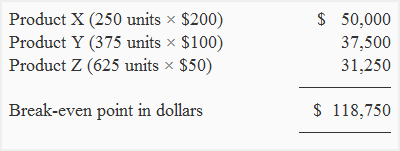
The company will have to sell 1,250 units to break-even. Now I would compute the number of units of each product to be sold:
Product X (1,250 × 20%): 250 units
Product Y (1,250 × 30%): 375 units
Product Z (1,250 × 50%): 625 units
Total:250 units + 375 units + 625 units = 1,250 units
Product Y (1,250 × 30%): 375 units
Product Z (1,250 × 50%): 625 units
Total:250 units + 375 units + 625 units = 1,250 units
As the number of units of each individual product to be sold have been computed, I can compute the break even point in dollars as follows:

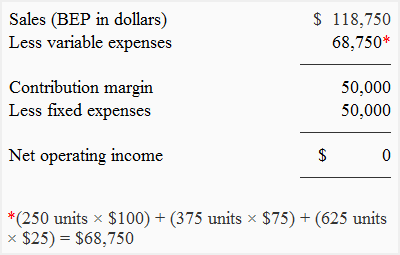
The break-even point of Monster company is $118,750. It can be verified by preparing a contribution margin income statement as follows:
Cost-Volume-Profit Analysis - formula
CVP formula
The BEP can be obtained either in units or in RM. Therefore it is important to know the relevant information needed to calculate using the the given formula;
To find how many units to produce to break-even,
BEP(units) = Fixed Cost/Contribution Margin
To find the break-even in Ringgit,
BEP(RM) = Fixed Cost/Contribution Margin %
Sometimes, we put a figure to target certain profit, the BEP in units,
BEP(units) = (Fixed Cost + Targeted Profit)/Contribution Margin
Same goes to the targeted profit, the BEP in Ringgit,
BEP(RM) = (Fixed Cost + Targeted Profit)/Contribution Margin %
Example 1
Below are the cost to manufacture product XYZ in period 1
Direct material RM 6
Direct labour 3
Direct expenses 2
Rental 5,000
Salary 12,000
Selling price RM 20
Solution;
Total Variable cost per unit (RM) = DM + DL + DE
= 6 + 3 + 2
= 11
Total fixed cost (RM) = Rental + Salary
= 5,000 + 12,000
= 17,000
Contribution margin (RM) = Selling price - Variable cost
= 20 - 11
= 9
Contribution margin(%) = CM/Selling price
= 9/20
= 45%
Using the formula;
BEP(units) = Fixed Cost/Contribution Margin
= 17,000/9
= 1,889 units
BEP(RM) = Fixed Cost/Contribution Margin %
= 17,000/45%
= RM37,778
Example 2
If the management wants an additional profit (targeted profit) then,
Targeted profit (RM) = RM10,000
BEP(units) = (Fixed Cost + Targeted Profit)/Contribution Margin
= (17,000 + 10,000)/9
= 3,000 units
BEP(RM) = (Fixed Cost + Targeted Profit)/Contribution Margin %
= (17,000 + 10,000/45%
= RM60,000
However, the above formula can only be applied for a single product.
If there are changes in the selling price, variable cost and fixed cost, the formula can be adjusted accordingly.
But.....in order to get this formula works for you, all of the above should remain constant at the time you are doing the calculation. All must be constant.
The BEP can be obtained either in units or in RM. Therefore it is important to know the relevant information needed to calculate using the the given formula;
To find how many units to produce to break-even,
BEP(units) = Fixed Cost/Contribution Margin
To find the break-even in Ringgit,
BEP(RM) = Fixed Cost/Contribution Margin %
Sometimes, we put a figure to target certain profit, the BEP in units,
BEP(units) = (Fixed Cost + Targeted Profit)/Contribution Margin
Same goes to the targeted profit, the BEP in Ringgit,
BEP(RM) = (Fixed Cost + Targeted Profit)/Contribution Margin %
Example 1
Below are the cost to manufacture product XYZ in period 1
Direct material RM 6
Direct labour 3
Direct expenses 2
Rental 5,000
Salary 12,000
Selling price RM 20
Solution;
Total Variable cost per unit (RM) = DM + DL + DE
= 6 + 3 + 2
= 11
Total fixed cost (RM) = Rental + Salary
= 5,000 + 12,000
= 17,000
Contribution margin (RM) = Selling price - Variable cost
= 20 - 11
= 9
Contribution margin(%) = CM/Selling price
= 9/20
= 45%
Using the formula;
BEP(units) = Fixed Cost/Contribution Margin
= 17,000/9
= 1,889 units
BEP(RM) = Fixed Cost/Contribution Margin %
= 17,000/45%
= RM37,778
Example 2
If the management wants an additional profit (targeted profit) then,
Targeted profit (RM) = RM10,000
BEP(units) = (Fixed Cost + Targeted Profit)/Contribution Margin
= (17,000 + 10,000)/9
= 3,000 units
BEP(RM) = (Fixed Cost + Targeted Profit)/Contribution Margin %
= (17,000 + 10,000/45%
= RM60,000
However, the above formula can only be applied for a single product.
If there are changes in the selling price, variable cost and fixed cost, the formula can be adjusted accordingly.
But.....in order to get this formula works for you, all of the above should remain constant at the time you are doing the calculation. All must be constant.
Cost-Volume-Profit Analysis
To know the content, we need to understand the title of this topic first. Cost-Volume-Profit Analysis is a process or to analyse how much the cost will be incurred for a certain volume in getting the desired profit from a production. Get it? Huh!
In simple terms.... for example, how many units we have to produce and how much money we have to pay to produce the units to get our targeted profit. Let's say, you produced 100 units of product X and of course you will know how much money you have to use to produce that product X. You will also know how much to sell and that will form your total revenue. Then compare the total revenue with the total cost of producing the product, you will then get your profit or loss from this transaction. From here, you can also find the break-even point in production. Hmmm...another term..break-even point...
Break-Even Point.
Simple explanation for the above term is...the point where you break! The point where you have no profit and no loss. Just ZERO. The total revenue equals with the total cost.
Total Revenue = Total Costs
TR = TC
(Selling Price x Units sold = Variable Cost + Fixed Cost)
I assumed you have already understood what are variable cost and fixed cost. If you don't, find those in this blog!
I give you an example... A fruit tart case
Selling price: RM4.00/unit
Units sold: 1000 units
Variable cost: RM1.50/unit
Fixed cost: RM2,500
The calculation is like this;
Total Revenue = Selling price x Units sold
= RM4.00 x 1,000 units
= RM4,000
Total Costs = Variable cost + Fixed cost
= (RM1.50 x 1,000 units) + RM2,500
= RM1,500 + RM2,500
= RM4,000
Therefore, TR=TC
There is no profit nor loss! That's why we called this Break-even point. With this price of RM4.00 per unit of fruit tart, you need to sell 1,000 units to cover the variable cost or fixed cost. If you sell more than 1,000 units, then you'll get profits. If you only managed to sell less than 1,000 units then you'll get a loss.
The above formula is a simple formula. There is another approach to arrive at the BEP.
Till next time!
Thursday, 2 August 2018
Go Penang
A trip worth planning for....
Penang
Malaysian state
Penang is a state in northwest Malaysia comprising mainland Seberang Perai and Penang Island. On the island, the state capital of George Town is home to landmarks such as colonial Fort Cornwallis, the ornate Chinese clan house Khoo Kongsi and the Kapitan Keling Mosque, all testaments to centuries of foreign influence. To the west, a funicular ascends Penang Hill, with its trails, flower gardens and panoramic views.
Population: 1.746 million (2017)
Proposed date: Somewhere in September 2018
Proposed stay: 3 day 2 nights
Travel mode: Backpackers trip, bus,
Accommodation: Homestay
Place of interest:
1. Penang ferry
Cost <RM5
2. Penang Hill
Cost RM10
Fast lane RM40
3. Padang Kota Lama (Esplanade)
Cost Free!
4. Street Art
Cost Free!
5. Komtar Skywalk
Cost RM88 (with MyKad)
6. Upside down museum
Cost RM15
7. Penang 3D Trick Art Museum
Cost RM15
8. Wonderfood museum
Cost RM15
9. Magic World Phantamania
Cost RM16
.....many more!
Dark Mansion museum
Magic mirror maze
Chowrasta
Talk about food....there are a lot!!!
Deen Nasi Kandar
Hameed Pata Mee Sotong
Breakfast stall at Transfer Road
...and many more
so guys.....How 'bout it?
Subscribe to:
Posts (Atom)