Showing posts with label Process Costing. Show all posts

Thursday, 27 September 2018

Process costing - Exercise 2


Below are the details for two departments in Proses Kos Sdn Bhd. Currently, the company is manufacturing a sofa set which involving Assembly Department and Painting Department.


Assembly (P1)
Painting (P2)
Direct material
RM160,000
RM85,000
Direct labour
RM  80,000
RM60,000
Direct expenses
RM  40,000

Overheads
40% of direct labour cost
RM42,000

The input for direct material for Assembly Department (P1) is 4,000 units. Normal loss is expected at 5% of input materials and all scrap can be sold for RM5.00 per unit. At the end the process 3,600 units were transferred to Painting Department.

The work in progress at the beginning of the period is 800 units which cost;
Input materials RM64,000, Added materials RM43,500, Direct labour RM18,640 and overhead RM6,100.

The work in progress at the end of the period is 500 units which consist of 70% of conversion cost.

At the end of the process, 4,200 units of finished products were transferred to store. Expected losses for this department are estimated to be 5% of production. All losses can be sold as scrap for RM12.00 per unit.

Tuesday, 25 September 2018

Process Costing - Exercise

Nur Cosmetics produces a skin care product known as “Floles”. The production is conducted at a factory where it has to undergo three different processes. The output of each process is treated as the raw material of the next process to which it is transferred and output of the third process is transferred to finished stock. The supervisor had already prepared all the relevant information as below;


1st Process
2nd Process
3rd Process
Material issued
30,000
20,000
10,000
Labour
8000
4,000
1,000
Overhead
12,000
10,000
15,000

10,000 units have been issued to the first process and after processing of each process is as under:

Output
Normal Loss
First process
9,700 units
2%
Second process
9,500 units
3%
Third process
8,700 unts
5%

No stock of materials or work-in-progress was left at the end.


Required:
Prepare the process accounts of each of the above process

Wednesday, 25 October 2017

ACC2232 - Cost Accounting (Revision)

What you need to know....


Economic Order Quantity - EOQ

What is an 'Economic Order Quantity - EOQ'

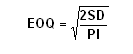
Economic order quantity (EOQ) is an equation for inventory that determines the ideal order quantity a company should purchase for its inventory given a set cost of production, demand rate and other variables. This is done to minimize variable inventory costs, and the formula takes into account storage, or holding, costs, ordering costs and shortage costs. The full equation is as follows:

Economic Order Quantity (EOQ)

where :
S = Setup costs
D = Demand rate
P = Production cost
I = Interest rate (considered an opportunity cost, so the risk-free rate can be used)

BREAKING DOWN 'Economic Order Quantity - EOQ'


The EOQ formula can be modified to determine different production levels or order interval lengths, and corporations with large supply chains and high variable costs use an algorithm in computer software to determine EOQ.

How Inventory Impacts Cash-Flow Planning


EOQ is an important tool for management to minimize the cost of inventory and the amount of cash tied up in the inventory balance. For many companies, inventory is the largest asset balance owned by the company, and these businesses must carry sufficient inventory to meet the needs of customers. If EOQ can help minimize the level of inventory, the cash savings can be used for some other business purpose.

Factoring in a Reorder Point


One component of the EOQ formula calculates a reorder point, which is a level of inventory that triggers the need to place an order for more inventory. By determining a reorder point, the business avoids running out of inventory and is able to fill all customer orders. If the company runs out of inventory, there is a shortage cost, which is the revenue lost because the company does not fill an order. Having an inventory shortage may also mean the company loses the customer or the client orders less in the future.

Example of Using EOQ


EOQ takes into account the timing of reordering, the cost incurred to place an order and costs to store merchandise. If the company is constantly placing small orders to maintain a specific inventory level, the ordering costs are higher, along with the need for additional storage space. Assume, for example, a retail clothing shop carries a line of men’s jeans and the shop sells 1,000 pairs of jeans each year. It costs the company $5 per year to hold a pair of jeans in inventory, and the fixed cost to place an order is $2. The EOQ formula is the square root of: (2 X 1,000 pairs X $2 order cost) / ($5 holding cost), or 28.284 with rounding. The ideal order size to minimize costs and meet customer demand is slightly over 28 pairs of jeans. A more complex portion of the EOQ formula provides the reorder point.


Inventory Valuation Methods Introduction

Inventory valuation methods are used to calculate the cost of goods sold and cost of ending inventory. Following are the most widely used inventory valuation methods:

  1. First-In, First-Out Method
  2. Last-In, First-Out Method
  3. Average Cost Method

First-in-First-Out Method (FIFO)


According to FIFO, it is assumed that items from the inventory are sold in the order in which they are purchased or produced. This means that cost of older inventory is charged to cost of goods sold first and the ending inventory consists of those goods which are purchased or produced later. This is the most widely used method for inventory valuation. FIFO method is closer to actual physical flow of goods because companies normally sell goods in order in which they are purchased or produced.

Last-in-First-Out Method (LIFO)


This method of inventory valuation is exactly opposite to first-in-first-out method. Here it is assumed that newer inventory is sold first and older remains in inventory. When prices of goods increase, cost of goods sold in LIFO method is relatively higher and ending inventory balance is relatively lower. This is because the cost goods sold mostly consists of newer higher priced goods and ending inventory cost consists of older low priced items.

Average Cost Method (AVCO)


Under average cost method, weighted average cost per unit is calculated for the entire inventory on hand which is used to record cost of goods sold. Weighted average cost per unit is calculated as follows:

Weighted Average Cost Per Unit=Total Cost of Goods in Inventory
Total Units in Inventory

The weighted average cost as calculated above is multiplied by number of units sold to get cost of goods sold and with number of units in ending inventory to obtain cost of ending inventory.


Written by Irfanullah Jan


Contract costing


Contract costing is the tracking of costs associated with a specific contract with a customer. For example, a company bids for a large construction project with a prospective customer, and the two parties agree in a contract for a certain type of reimbursement to the company. This reimbursement is based, at least in part, on the costs incurred by the company in order to fulfill the terms of the contract. The company must then track the costs associated with that contract so that it can justify its billings to the customer.

The most typical types of cost reimbursement are:
  • Fixed fee. The company is paid a fixed total amount for completing the project, possibly including progress payments. Under this arrangement, the company will want to engage in contract costing to compile all of the costs relevant to the construction project, just to see if the company earned a profit on the deal.
  • Cost plus. The company is reimbursed for the costs it incurred, plus a percentage profit or fixed profit. Under this arrangement, the company will be forced under the terms of the contract to track the costs related to the project, so that it can apply to the customer for reimbursement. Depending on the size of the project, the customer may send an auditor to examine the company's contract costs, and may disallow some of them.
  • Time and materials. This approach is similar to the cost plus arrangement, except that the company builds a profit into its billings, rather than being awarded a specific profit. Again, the company must track all contract costs carefully, since the customer may review them in some detail.
Contract costing can involve a considerable amount of overhead allocation work. Customer contracts typically specify exactly which overhead costs can be allocated to their projects, and this calculation may vary by contract.
In some industries, such as government contracting and commercial construction, contract costing is the primary task of the accounting department, or may even be organized as an entirely separate department. Proper contract costing can contribute a considerable amount of profits, and so is typically staffed with more experienced contract managers and accountants.


Process Costing


Thursday, 28 September 2017

ACC2232 - Process Costing

Process Costing

Process costing is a costing method used when it is not possible to identify separate units of production, or jobs, usually because of the continuous nature of the production processes involved. Process costing traces and accumulates direct cost, and allocates indirect cost incurred during a manufacturing process.

The following are examples of some of the industries which use process costing:
  1. Oil refineries
  2. Soap manufacturers
  3. Paint manufacturers
  4. Sugar manufacturers

Features of Process Costing

The following features distinguish process costing from other costing methods:
a) The continuous nature of production in many processes means that there will usually        be closing work in progress which must be valued. In process costing it is not possible      to build up a cost record of the cost incurred on individual units of output because            production in progress is an indistinguishable homogeneous mass.
b) The output of one process becomes the input of the next,unless it is the final process,        culminating in the finish product.
c) Losses often occur during the process due to spoilage, wastage, evaporation and so on.
d) Output from production may be a single product, but depending on the industry there      may also be by-products and joint products.
Process accounts are used to accumulate the cost incurred during a process. The following four step approach is used to complete the process accounts, minimizing the chances of error:
i. Determine output and losses
ii. Calculate cost per unit of output, losses and work in progress
iii. Calculate total cost of output, losses and work in progress
iv. Complete accounts
Example:
The input to a process is 2,000 units at a cost of $ 9,000. Normal loss is 10%. No opening and closing stocks. Complete the process accounts if output is 1660 units

Solution:
Before solving the example, the following points should be noted.
a. Normal loss is given no share of cost. Therefore, the cost of output will be based on 90% of units completed i.e. 2,000 @ 90% = 1,800
b. Abnormal loss will be given a cost. Abnormal loss=Total loss – Normal loss

Step 1:
Now, to complete the process account the first step is to determine output and losses

Total Input = 2,000
Output = 1,660
Normal Loss = 200
Abnormal Loss = 140

Step 2:
Calculate cost per unit of output and losses
Total Cost Incurred / Expected Output = 9,000 / 1,800 = $5 per unit

Step 3:
Calculate total cost of output and losses

Output = $8,300
Normal Loss = Nil
Abnormal Loss = $700

Step 4:

Process accounts
Particular
             Units
         Amount ($)
        Particular
     Units
      Amount ($)
Cost Incurred
             2,000
9,000
          Normal Loss
200
0
Abnormal Loss
140
700
Output
1,660
8,300
2,000
9,000
2,000
9,000

from readyratios.com

Illustration

Neo Pharma process a product through three distinct stages, these production of on process being passed on to the next process and so on to the finished product. Details of the cost incurred in each process are given below.

Process A Process B Process C
Raw Material1000800200
Direct Wages500600700
Direct Expenses150250500

The overhead expenses or the period amount to RM 3600 and is to be distributed to the process on the basis of direct wages.

There were no stocks in any of the process either at the beginning or at the close of the period.
Assuming the output was 1000 kilos, show the process cost of A, B and C indicating also the cost per kilo of each element of cost and the output in each process.

If 10% of the output is lost in storage and giving samples, what should be the selling price per unit to make a gross profit of 33.33% on the selling price.

Process A Account 


DebitAmountCreditAmount
Raw Material1000Process B Account2650
Direct wages500
Direct Expenses150
Overheads1000
26502650

Process B Account 


DebitAmountCreditAmount
Process A Account2650Process C Account5500
Raw Material800
Direct Wages600
Direct Expenses250
Overhead1200
55005500

Process C Account 


DebitAmountCreditAmount
Process B Account5500Finished Stock Account8300
Raw Material200
Direct Wages700
Direct Expenses500
Overhead1400
83008300


If 10% is lost
Total Output = 900 Kgs
Total Cost = RM 8300
Cost Per Kg = 8300 / 900 = RM9.22
Selling Price to earn 33.33% on Selling price
Cost price = 100 - 33.33 = RM66.67
If cost is RM66.67, sale value = 100
If cost is RM1, sale value = 100 / 66.67
If cost is RM 8300, sale value = 100/66.67 X 8300 = 12449.37
Selling price per unit = 12449.37/900 = RM 13.83


- from http://www.svtuition.org