Showing posts with label Inventory Valuation. Show all posts

Monday, 22 April 2019

Stock evaluation

Dear students,

Sorry for the late posting. But below as promised, hahahaha!

The following information relates to the material purchases and issues for the month of May 2019;

May 2019


5
Issued to production
100kgs
10
Purchased
300kgs at RM6.80 per kg
15
Issued to production
250kgs
18
Purchased
100kgs at RM7.00 per kg
20
Issued to production
120kgs
22
Issued to production
80kgs
25
Purchased
100kgs at RM7.40 per kg

The balance of raw material on 1 May 2019 consists of 50kg at a price of RM6.50 per kg which were bought in April 2019 and another 100kg was purchased on March 2019 at a price of RM6.00 per kg. 


Required;
Prepare a Store Ledger Card to record the above transaction in May, using First-in First-out (FIFO), Last-in First-out (LIFO) and Weighted average method.

See you tomorrow guys!!


Wednesday, 30 May 2018

ACC2233 - Short Quiz

Assalamualaikum and dear students,

This is our final round of quiz. Marks will be given to the fastest all correct answers. Snap your answer and yippi me ASAP.

Relax, marks will also be given to those who are late but will rated according to the time ranking.

Happy finals!


Short Quiz
1.       A machine costing RM12,000 was sold to a client on hire purchase term  in January 2016. The cash price of the machine was RM16,000. The interest rate was fixed to be 8% per annum which is payable on 31 December each year. The depreciation rate for the machine is 20% per annum at cost. Instalment payment was agreed for RM3,200 plus interest charged during the year.
Required: (in the book of purchaser)
        a)      Asset account
        b)      Hire purchase creditor account
        c)       Provision for depreciation account


2. The above machine was confiscated in March 2019 due to failure of instalments payment. The supplier took the machine with zero compensation.

Required : (in the book of purchaser)
        a)      Asset disposal account


3.   Independent from the above question, assuming the machine instalment was fixed at RM3,772 per annum for 5 years, then…

Required: (in the book of seller)
       a)      Hire purchase seller account
       b)      Hire purchase debtor account
       c)       Hire purchase interest account


4.   Haslita acquired a vacant factory at a cost of RM620,000. During the process, she has to pay for the stamp duty worth RM1,200, legal fees to Tetuan Khatijah & Co for RM10,500, a bribe to a Minister RM50,000. She also has to build a new fence around the factory to safeguard her trucks amounting RM13,000.

Required:
Calculate the initial cost for the above to be recognized in the Statement of Financial Position at the end of the year.

Calculate the following using the FIFO and Weighted Average method;

Date
Transactions
Mar     1
Purchased 70 units at RM15 each
         3
Sold 25 units at RM22 each
        4
Purchased 20 units at RM16 each
       6
Sold 40 units at RM23 each
9
Sold 20 units at RM24 each
12
Purchased 30 units at RM15.50 each
13
Sold 15 units at RM22 each

Wednesday, 25 April 2018

ACC2232 - Inventory Valuation

Try this....

Puteri trading company involved in the marketing of computer gadgets using “Nabilla” as the brand name. Samihah is a trained accountant was called to advise the management which method should the company adopt for inventory valuation. The following information regarding the inventory valuation for the month of August 2017 is as below.
  • Aug. 01: Beginning inventory, 600 units @ RM5 each each.
  • Aug. 10: Sold 400 units @ RM12 each.
  • Aug. 11: Purchased 1,600 units @ RM6 each.
  • Aug. 15: Sold 1,000 units @ RM12.50 each.
  • Aug. 20: Purchased 1,000 units @ RM6.50 each.
  • Aug. 27: Sold 600 units @ RM13.50 each.
Puteri had decided to apply the two inventory valuation method, that are First-in-First-Out (FIFO) and Weighted Average (WA).


Wednesday, 25 October 2017

ACC2232 - Cost Accounting (Revision)

What you need to know....


Economic Order Quantity - EOQ

What is an 'Economic Order Quantity - EOQ'

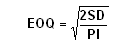
Economic order quantity (EOQ) is an equation for inventory that determines the ideal order quantity a company should purchase for its inventory given a set cost of production, demand rate and other variables. This is done to minimize variable inventory costs, and the formula takes into account storage, or holding, costs, ordering costs and shortage costs. The full equation is as follows:

Economic Order Quantity (EOQ)

where :
S = Setup costs
D = Demand rate
P = Production cost
I = Interest rate (considered an opportunity cost, so the risk-free rate can be used)

BREAKING DOWN 'Economic Order Quantity - EOQ'


The EOQ formula can be modified to determine different production levels or order interval lengths, and corporations with large supply chains and high variable costs use an algorithm in computer software to determine EOQ.

How Inventory Impacts Cash-Flow Planning


EOQ is an important tool for management to minimize the cost of inventory and the amount of cash tied up in the inventory balance. For many companies, inventory is the largest asset balance owned by the company, and these businesses must carry sufficient inventory to meet the needs of customers. If EOQ can help minimize the level of inventory, the cash savings can be used for some other business purpose.

Factoring in a Reorder Point


One component of the EOQ formula calculates a reorder point, which is a level of inventory that triggers the need to place an order for more inventory. By determining a reorder point, the business avoids running out of inventory and is able to fill all customer orders. If the company runs out of inventory, there is a shortage cost, which is the revenue lost because the company does not fill an order. Having an inventory shortage may also mean the company loses the customer or the client orders less in the future.

Example of Using EOQ


EOQ takes into account the timing of reordering, the cost incurred to place an order and costs to store merchandise. If the company is constantly placing small orders to maintain a specific inventory level, the ordering costs are higher, along with the need for additional storage space. Assume, for example, a retail clothing shop carries a line of men’s jeans and the shop sells 1,000 pairs of jeans each year. It costs the company $5 per year to hold a pair of jeans in inventory, and the fixed cost to place an order is $2. The EOQ formula is the square root of: (2 X 1,000 pairs X $2 order cost) / ($5 holding cost), or 28.284 with rounding. The ideal order size to minimize costs and meet customer demand is slightly over 28 pairs of jeans. A more complex portion of the EOQ formula provides the reorder point.


Inventory Valuation Methods Introduction

Inventory valuation methods are used to calculate the cost of goods sold and cost of ending inventory. Following are the most widely used inventory valuation methods:

  1. First-In, First-Out Method
  2. Last-In, First-Out Method
  3. Average Cost Method

First-in-First-Out Method (FIFO)


According to FIFO, it is assumed that items from the inventory are sold in the order in which they are purchased or produced. This means that cost of older inventory is charged to cost of goods sold first and the ending inventory consists of those goods which are purchased or produced later. This is the most widely used method for inventory valuation. FIFO method is closer to actual physical flow of goods because companies normally sell goods in order in which they are purchased or produced.

Last-in-First-Out Method (LIFO)


This method of inventory valuation is exactly opposite to first-in-first-out method. Here it is assumed that newer inventory is sold first and older remains in inventory. When prices of goods increase, cost of goods sold in LIFO method is relatively higher and ending inventory balance is relatively lower. This is because the cost goods sold mostly consists of newer higher priced goods and ending inventory cost consists of older low priced items.

Average Cost Method (AVCO)


Under average cost method, weighted average cost per unit is calculated for the entire inventory on hand which is used to record cost of goods sold. Weighted average cost per unit is calculated as follows:

Weighted Average Cost Per Unit=Total Cost of Goods in Inventory
Total Units in Inventory

The weighted average cost as calculated above is multiplied by number of units sold to get cost of goods sold and with number of units in ending inventory to obtain cost of ending inventory.


Written by Irfanullah Jan


Contract costing


Contract costing is the tracking of costs associated with a specific contract with a customer. For example, a company bids for a large construction project with a prospective customer, and the two parties agree in a contract for a certain type of reimbursement to the company. This reimbursement is based, at least in part, on the costs incurred by the company in order to fulfill the terms of the contract. The company must then track the costs associated with that contract so that it can justify its billings to the customer.

The most typical types of cost reimbursement are:
  • Fixed fee. The company is paid a fixed total amount for completing the project, possibly including progress payments. Under this arrangement, the company will want to engage in contract costing to compile all of the costs relevant to the construction project, just to see if the company earned a profit on the deal.
  • Cost plus. The company is reimbursed for the costs it incurred, plus a percentage profit or fixed profit. Under this arrangement, the company will be forced under the terms of the contract to track the costs related to the project, so that it can apply to the customer for reimbursement. Depending on the size of the project, the customer may send an auditor to examine the company's contract costs, and may disallow some of them.
  • Time and materials. This approach is similar to the cost plus arrangement, except that the company builds a profit into its billings, rather than being awarded a specific profit. Again, the company must track all contract costs carefully, since the customer may review them in some detail.
Contract costing can involve a considerable amount of overhead allocation work. Customer contracts typically specify exactly which overhead costs can be allocated to their projects, and this calculation may vary by contract.
In some industries, such as government contracting and commercial construction, contract costing is the primary task of the accounting department, or may even be organized as an entirely separate department. Proper contract costing can contribute a considerable amount of profits, and so is typically staffed with more experienced contract managers and accountants.


Process Costing


Monday, 23 October 2017

ACC2232 - Revision - Inventory Valuation

Assalamualaikum,

Attached is the revision exercise for the said topic. Print this. I may not come to class due to my aunt has passed away while I'm doing this exercise. InsyaAllah see you later on Wednesday.

Monday, 7 August 2017

Wednesday, 2 August 2017

ACC2232 - Inventory Control and Valuation

In order for the organization to stay competitive, the inventory control and valuation is important. An inventory valuation allows a company to provide a monetary value for items that make up their inventory. Inventories are usually the largest current asset of a business, and proper measurement of them is necessary to assure accurate financial statements. If inventory is not properly measured, expenses and revenues cannot be properly matched and a company could make poor business decisions.

For your benefits, let's watch some short videos regarding the valuation of inventory.


The two most widely used inventory accounting systems are the periodic and the perpetual.
  • Perpetual: The perpetual inventory system requires accounting records to show the amount of inventory on hand at all times. It maintains a separate account in the subsidiary ledger for each good in stock, and the account is updated each time a quantity is added or taken out.
  • Periodic: In the periodic inventory system, sales are recorded as they occur but the inventory is not updated. A physical inventory must be taken at the end of the year to determine the cost of goods
Regardless of what inventory accounting system is used, it is good practice to perform a physical inventory at least once a year.


JUST IN TIME (JIT)
  • No material are purchased and no product are manufactured until they are needed
  • To reduce or eliminate inventories at every stage of production
  • Minimize storage cost

FIFO (First In First Out)
  • First material in will be the first material issued
  • Most logical method and accepted by IRB
  • Lower cost, higher profit

LIFO (Last In First Out)
  • Most recent material received, will be the first to be issued
  • Not really logical and not accepted by IRB
  • Higher cost, lower profit

WEIGHTED AVERAGE
  • Material issued is valued at average cost price
  • Accepted by IRB
Weighted Average =Total Cost of Inventory
Unit CostTotal Units in Inventory

Like FIFO and LIFO methods, AVCO is also applied differently in periodic inventory system and perpetual inventory system. In periodic inventory system, weighted average cost per unit is calculated for the entire class of inventory. It is then multiplied with number of units sold and number of units in ending inventory to arrive at cost of goods sold and value of ending inventory respectively. In perpetual inventory system, we have to calculate the weighted average cost per unit before each sale transaction.

There are so many videos you can find in the YouTube. Varies in minutes duration but why not? Just spend a couple of minutes to understand various presentations. Who knows, you might get addicted! Hahaha

I also uploaded the a calculation sheet to calculate the FIFO, LIFO and WACO. If possible try to download this, make 3 copies and we will use them in class.

Download this... Store Ledger Card


Example - FIFO

Use the following information to calculate the value of inventory on hand on Mar 31 and cost of goods sold during March in FIFO periodic inventory system and under FIFO perpetual inventory system.
Mar 1Beginning Inventory68 units @ $15.00 per unit
5Purchase140 units @ $15.50 per unit
9Sale94 units @ $19.00 per unit
11Purchase40 units @ $16.00 per unit
16Purchase78 units @ $16.50 per unit
20Sale116 units @ $19.50 per unit
29Sale62 units @ $21.00 per unit


Example - LIFO

Use LIFO on the following information to calculate the value of ending inventory and the cost of goods sold of March.
Mar 1Beginning Inventory60 units @ $15.00
5Purchase140 units @ $15.50
14Sale190 units @ $19.00
27Purchase70 units @ $16.00
29Sale30 units @ $19.50

Example - AVCo

Apply AVCO method of inventory valuation on the following information, first in periodic inventory system and then in perpetual inventory system to determine the value of inventory on hand on Mar 31 and cost of goods sold during March.
Mar 1Beginning Inventory60 units @ $15.00 per unit
5Purchase140 units @ $15.50 per unit
14Sale190 units @ $19.00 per unit
27Purchase70 units @ $16.00 per unit
29Sale30 units @ $19.50 per unit

ACC2232 - Economic Order Quantity (EOQ)

What is EOQ?


EOQ is the acronym for economic order quantity. The economic order quantity is the optimum quantity of goods to be purchased at one time in order to minimize the annual total costs of ordering and carrying or holding items in inventory.EOQ is also referred to as the optimum lot size.
 
The formula to calculate the economic order quantity is the square root of [(2 times the annual demand in units times the incremental cost to process an order) divided by (the incremental annual cost per unit to carry an item in inventory)].


EOQ 1EOQ 2

 
HOLDING COST
  •  Interest on fund borrowed
  •  Storage charges (rent)
  •  Insurance and security
  •  Cost of obsolescence of stocks

ORDERING COST
  •  Clerical costs preparing purchase order and transportation

ORDERING COST
  •  Cost without having stock
  •  Loss of contribution
  •  Loss of customer future sale/goodwill
  •  Production stoppage
 
Let's try this!
 
Annual demand quantity : 1500 units
Ordering cost: RM30 per order
Cost per unit of item: RM5
Holding cost: 20% of inventory cost
 
Calculate the EOQ.
 
Another one...
 
Nadzmi runs a mail-order business for gym equipment. Annual demand for the AbsFlexer is 16,000. The annual holding cost per unit is $2.50 and the cost to place an order is $50. What is the economic order quantity?
 
However, the EOQ implementation has to be based on the following assumptions....
 
Assumptions:
  • Demand is constant
  • Holding and ordering cost are constant
  • Unit price is constant
  • Quick delivery
  • Replenishment is made instantaneously (the whole batch is delivered at once)